Sunday, November 1, 2015

Observing to See....Children and Each Other


So many videos, so little time.

I am scrolling through my Facebook newsfeed when Seeing Children, a video by Melissa Scott, who works at the University of Chicago Laboratory School, pops up.  Hmmm, 11 minutes long....do I have 11 minutes?  Sure.

Watch it now, don't wait.
Because boy is it worth the time.

Scott deftly captures the bind many teachers are in - caught between assessment and authentic interactions with children, between play and work, between observing as an act of compliance and observing to really inform instruction and know children.    Scott moves between her experiences using Teaching Strategies Gold and then reframes the observation of a child to make meaning of who the child is and what he has accomplished.   Teachers in Somerville raised the same questions Scott raises about TSG, and yet they also recognize the importance of collecting good data about children and using it to plan instruction.

We know we need to continually observe children, but what about each other? Teachers at the Capuano Early Childhood Center in Somerville wanted to know more about Peer Observation, craving time to observe in classrooms other than their own, but needed a structure to accompany this work.  And so this week during professional development time, we begin to examine the purposes of Peer Observation.  An article from EdWeek about peer observation frames the risk teachers take by inviting each other into their classrooms as a heroic act.   Teachers love autonomy, but often that means "leave me alone to do my work in peace".   How can we SEE each other's work more clearly?

At the heart of Peer Observation is feedback.  However this doesn't have to mean constructive criticism, or even appreciative inquiry about the classroom you observed.  Visits can be for the observer and a protocol such as First Classroom Visits from The School Reform Initiative can be a powerful, yet non-threatening tool to help the observer think more deeply about their own practice.  Teachers at Capuano will begin by thinking about the how classroom visits benefit the observer - and about how having a guiding question about your work can open the door to new ways of thinking.

  • What are your questions about your own work?
  • How might observing in a colleague's classroom open your eyes to new practices?
  • How can close observation of children's work and play address your questions about your own teaching? 

This kind of thinking doesn't always come naturally in the busy lives of teachers and intentionally surfacing our questions, taking the time to SEE children and each other, is a worthwhile endeavor.

We will let you know what we see.

Sunday, October 18, 2015

Designing Classrooms for Learning

This past summer early childhood educators in Somerville took part in a workshop: Creating Beautiful Environments for Learning.  Teachers were asked to think about the question: Where do you do your best work? They tackled topics such as what to put on the walls, minimizing overstimulation and clutter, setting up rooms to provide learning areas, and making materials accessible to children. Most participants said that one of their main goals was to create distinct areas in their rooms, as well as eliminate the "sea of tables" that was usually the focal point of their rooms.

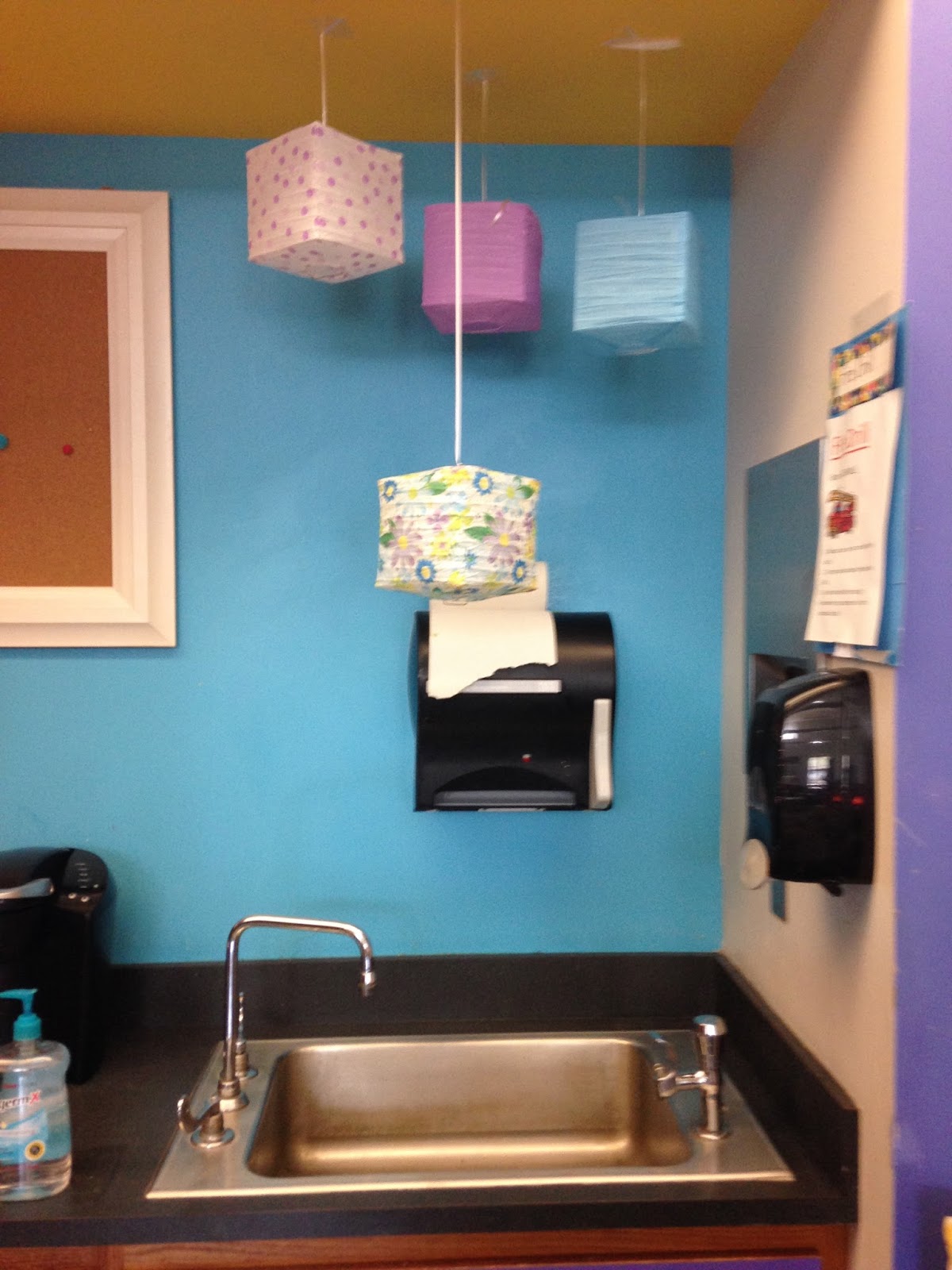
We know that people respond to color, things on the walls, and the way materials are set up. Teachers learned about elements of design that create beauty and a "homey" feel to classrooms - so important in making young children feel safe and comfortable at school. As part of the workshop teachers practiced their new skills by giving four lucky teachers a room makeover. Here are a few highlights from the workshop and the changes some teachers have begun to make, and possible entry points for your room arrangement journey.

The Early Education Department in Somerville is available to help Somerville early educators with their classrooms via our instructional coaching services.  Contact lkuh@k12.somerville.ma.us

1.  Conduct a Furniture Inventory

As teachers worked, the furniture piled up in the halls.  Everyone was amazed to see how much they didn't need and that less was indeed more. What can you do without?  How many chairs do you need, beyond one for every child?  What are you holding onto that you can put into storage, or offer to another center?


Without all the extra furniture the room took on a more open, expansive feeling. It also created a "clean slate" so that children's work could be the foundation of the decor. This more minimalist approach can feel strange given the preponderance of catalogue decorations, but it allows children's work and learning to be the first thing we put up. 


2. Create Inviting Spaces - Boost the "Cozy Factor"

The over abundance of furnishings made the group reconsider the need for chairs at every table. Tables where children can kneel help develop a stronger core, more children can fit around them fostering collaboration, and the space is more inviting.


Placing materials in clear containers and carefully sorting makes the shelves more attractive, less cluttered and draws children to the space.  Aa an alternative to posters, choose something simple that is calming to the eye creates a soothing environment. 

3. Bring the Lighting Down - Create a "Homey" Feeling 

Small table lamps are a wonderful contrast to harsh or dull fluorescent lighting. Teachers reported increased visits to areas with this kind of lighting. 


4.  Make Displays Authentic and Reflect Children's Learning


Which of these photos might help children better understand the properties of a triangle? What can you create with children to display rather than spending money on catalogue items?


While it is easy to put all children's identical work in a grid-like arrangement on a bulletin board, think about adding photographs that show how children created the work, hang things from the ceiling, lose the colorful borders and overly bright backgrounds to make children's work "pop".

When teachers thought about the question, Where do you do your best work?, they said things like uncluttered spaces, good lighting, comfortable furnishings, quiet, time to work, and places to be creative.   Don't our children deserve the same?

Monday, September 7, 2015

The Curriculum Starts Today!

A few years ago I was working with some new teaching assistants who had little classroom experience.  About 3 weeks into school we were having our weekly team meeting and I could tell they both had something to say.  Finally one of them broke the tension.  "What we want to know is.....when is the curriculum starting?"

They were surprised to find out they had already been "doing curriculum" for weeks, and actually even before the children arrived.

For young children, curriculum means more than reading, writing, and mathematics - core areas we most often associate with curriculum content.  While activities associated with the more commonly known areas can emerge days or weeks into school, certain routines and concepts need to begin right away so that children know how to use materials, routines can be established, community built, and practices experienced and repeated.


Introducing Materials

           Guided Discovery
           Presentation and naming of materials
           How to take something out and use it
           Intentional teaching about a material
           Steps for engaging in a game or activity
          
Routines
           Coming to the rug for Whole Group
           Sitting on the rug for Whole Group – Multiple seating positions
           Leaving the rug and going to a center
           Pushing in chairs, moving chairs, getting in and out of a chair
           Treating the classroom and materials with care.
           Carrying materials
           Cleaning up and putting things away
           Practicing independent work without an adult
           Free exploration of materials
Walking around the building, classroom spaces
          
Social Emotional  
           Building community
           The classroom belongs to all of us
           What do children do when they want to say something?
           How do you interrupt or ask for help?
           How to share space and materials with others
           Asking reflecting questions – "How did you know that?"
 
Early Math Content
           Collections and sorting, ordering objects, grading, classifying
           Real Graphing, Morning questions (link)
           Building, blocks (table top and on rugs)
           Connecting things and taking them apart: 
(collage, manipulatives, construction materials)
           Counting – ANYTHING!  ALL THE TIME!

Early Literacy Content
Looking at books
Listening to read-alouds at story time
Free drawing
Writing words on children's pictures
Writing children's stories as they dictate them
Offering a variety of writing materials: 
(various sized paper, little books at choice time)
Lots of fine motor opportunities:
(pegs, beads, eye droppers, tongs, etc.)
Choral reading morning messages
Helping children recognize and write their names
(copying and tracing)

Part of the development of curriculum lies in the relationship between teacher and child, and the transfer of responsibility and ownership from teacher to child. These are elements of good teaching.

I asked the children, “Whose room is this?”  There was the usual consternation as they tried to guess. Finally I said, “I’ll give you a hint. It doesn’t belong to the adults.”
“It belongs to the kids!” they said incredulously, exchanging looks of disbelief.  
This is a special moment in the beginning of each class for me. The children’s faces and tone clearly show that I am presenting them with a new experience in their lives.
“Yes, it is yours, to work in and take care of, and I will show you how to take care of it.”
(Paula Polk Lillard)  

The curriculum for a group of children moving up from one classroom to another in a child care or center-based program, or those beginning the first day of school in a public school, begins on day one. The first smile from the teacher, the first "Good Morning!" is where curriculum in early childhood starts. 


Monday, July 27, 2015

Summer Learning for Teachers and for Children

Much has been written about the concept of summer learning loss for children. Somerville Public Schools provides programming for over 1000 students of all ages, combining fun experiences and keeping the learning going in order to start the year off right.

But the students aren't the only ones learning and having fun. Our teachers are learning too.  In early childhood, teachers often work all year - either in summer programs, or in childcare programs that provided care for working families year round. And, teachers take the time to further their own learning during the summer.

This spring and summer, SPS offered a small catalogue of workshops open to early childhood educators from across the city.  In any given workshop, Head Start, family childcare, center-based program, and Somerville Public School teachers learn side by side.   Offerings from May-August include:
  • Spring Into Science - Worms and Insects
  • Using Personal Dolls to Promote Anti-Bias Education
  • Music for Transitions - Self Regulation and Play
  • Using Photographs with Children and Families: Making Learning in Your Classroom Visible
  • Summer Science Academy: Explorations with Water
  • The Art of Loose Parts in the Classroom: The Beautiful Stuff Project
  • Understanding Trauma:  Getting your Students Back on Track for Learning
  • Preparing Early Childhood Classrooms for Learning:  Creating Beautiful Environments
The photos below illustrate just some of the learning that has been happening!

Teachers learned some of the techniques to take high quality photos of children and practiced with each other.  They also brought photos from their sites and practiced make displays of photographs that communicate student learning to parents, children, and the public.


Mary Rizzuto, science educator, spent two days making teachers feel like scientists themselves.  Teachers engaged in experiments related to properties of water such as surface tension, bouancy, absorption, and cohesion.  All of these apply to work children can do in the classroom in sensory tables and in more intentionally designed experiences.

Mary Rizzuto gives the next directions 
for a sink and float activity.
Changing the variables of objects, like using these density cubes (same size, different materials and weights), helps teachers and children make predictions, observe phenomena, and come to a great understanding about why things sink and float.

Teachers make predictions about which objects will float and which will sink.
Making the time to take a workshop and actually getting there (getting a sub for your students, making sure your own family's needs are attended to, taking time off work) is half the battle in professional development. But the hardest part of professional development might be what happens after the workshop is over.  Research shows us that the transfer of professional development activities into actual practice is scant - why so?

The busy lives of teachers and competing demands make it hard.  Once teachers go back into their classrooms, it can be difficult to make room for new practices. What makes a difference?

Teachers find that making a commitment can help.  This means accountability to a group in the form of written plans, new habits, materials. Sharing even one small new way of working can help instill a new practice and inspire others to do the same.  We included content on planning and follow up in our professional development workshops to help teachers stay on track with new learning.  Padlets, DropBox, follow up emails all encourage teachers to share their work with each other and we hope to post some of those new practices here in the coming months!


Tuesday, June 30, 2015

Somerville Early Childhood Teachers: Following Children's Interests and Supporting Development

Over the past year, early childhood teachers in Somerville Public Schools, Head Start, and center-based community programs have been engaged in professional development focused on play and learning. One thing they found was that when they carefully prepared the classroom for play, children had richer experiences socially and intellectually. There was more language (vocabulary and communication exchanges), children stayed in a role for a longer time (which builds self-regulation), and they developed more complex play themes demonstrating higher level thinking and problem solving.

Photos & text from seed catalogues

Refrigerator turned store conveyer belt


For example, ECIP (early childhood intervention program) teacher Joan Duffy set up a garden center in her Capuano classroom in conjunction with a unit on the study of plants.  She noticed that the children wanted to buy plants and were trying to mimic the set up of a real store - they needed that conveyer belt that moves the groceries along.  The teacher turned the play fridge on its side, covered it with poster board and ta da! - a new element of the garden center inspired by children's needs.

Making signs and money

At the same time, Mrs. Duffy engaged in some district and city-wide practices - incorporating literacy in dramatic play. Children naturally wanted to make money and signs - and so writing became a part of the play experience.


Artificial flowers in styrofoam


Garden centers were popping up in classrooms all over the city - at the Bigelow Cooperative preschool children made flower arrangements with artificial flowers and a styrofoam base.  This simple activity gives children the chance to practice color sorting and fine motor skills. They also started their own plantings as part of a life sciences unit - combining real world activity and play.


Another teacher in Somerville took a different approach to scaffolding play experiences that support cognitive development and build on children's interests.  Nelleke Harris, kindergarten teacher at the East Somerville Community School, had children work cooperatively in small groups to engage in one of their favorite activities, building with Legos.  She took photos of children's constructions as they worked and then projected the creations onto the classroom SmartBoard.  After children finished building they gathered on the rug to compare the constructions, describe what they built and how they built it (an important cognitive skill - reflecting and reviewing), and then received feedback from other groups on their work.


This all happened in "real time" - it was part of a warm up activity children did when they arrived (the lego constructions), and then moved into a meaningful morning meeting with sophisticated exchanges among 5-year olds!


Finally, this is also the time of year for us to revel in children's explosion into writing.  Children between the ages of 3 and 5 are driven to put marks on paper.  Those scribbles you see are really a child's attempt to communicate in writing.  Somerville teachers engaged in the Literacy Coaching Group have focused this year on fine motor skills, exposure to print, real-life opportunities

The playbill for a version of Caps for Sale at the
Argenziano SMILE preschool program
for writing, and building writing centers into their classrooms.  This group received monthly and weekly visits from district Early Childhood Coaches, and met 3 times during the year as a professional learning community to share and learn about new practices. 


One of the unique things about this group is that it is made up of Somerville Public School preschool teachers, Head Start teachers, and teachers from center-based community programs at the YMCA Preschool and the Elizabeth Peabody House.  These kinds of groups are a way to create alignment between the activities happening in SPS and those in the community across Somerville - teachers learn from each other and our city comes closer to developing shared practices that benefit all children. 

Sometimes a small book, 3x3, is more enticing 
than a large piece of paper
A teacher shares a child's story in a little book

While the Somerville Public Schools come to a close this week, early childhood education continues throughout the summer, particularly in the birth through age 4 range. Children whose parents are working require care, and our formal and informal providers in the city work year-rounds to serve children and families.  In addition, Somerville provides some programming for children who will enter kindergarten in the fall and would benefit from a "get ready for kindergarten" program.  In addition, summer is a time when teachers engage in concentrated professional development and this year SPS is providing 6 free early childhood workshops to teachers from all kinds of programs on topics such as music, art, documenting children's work, helping children who have experienced trauma, science, and preparing classroom environments. So the good work continues, year round, and stay tuned for more from our Somerville early educators.

Happy Beginning of Summer!


Saturday, June 6, 2015

Who Are You Accountable To?

Please sign up to receive the blog automatically by entering your email in the "follow" box on the right.

This month teachers all over the country are conducting end of year assessments, preparing for progress reports and report cards, and entering data points on more formal, summative assessments. It is important to know how children have progressed, where they are in their learning trajectories, and how they are doing overall.  This makes me think about, as educators:

Who are we accountable to in our work?

Metrics take many forms and we need a variety. Some metrics are personal and qualitative - they tell a story and make the nuances of learning visible.
Others are quantitative and allow us to quickly and easily see measures of particular elements of development and children's progress.

However, increasingly, we do our work in an atmosphere of "finish your peas before you have dessert". This climate permeates our schools, policies, and the statehouse.

"Enter your data points before we give you the money the children deserve."
"Finish your work before you can play."

The irony here is that dessert is often the healthy fruits of play and inquiry, and not just Twinkies.

I have written before about this false dichotomy between play and academics as have others.  Lillian Katz recently asked us to stop thinking in terms of academics vs. play and focus on children's intellectual pursuits writ large. If we think in terms of intellectual goals, instead of purely academic goals, we might be able to turn the tables on this disconnect.

Do we need to assess children's development as they grow? Yes.
Our accountability is to children and families first and foremost.
And as educators, our accountability is also to ourselves and colleagues.  We must continually ask ourselves:

What do we stand for?
What is our image of children and what do we know they can do?
What is our agreed upon stance to how we will support children in their work and play?
What is our philosophy about how children learn and how must that inform our teaching?
What do we teach and how?
How will we know that children are learning?
How will we share the evidence and stories about children's learning with each other, with families, and with children?
How will we share it with district administrators, our community at large, and to our policy makers?

We have some work to do, but let's make it visible to everyone and use this work to bring us together as a field.  Early childhood education IS hard work and requires very specific skills and knowledge. The children are counting on us.

Who are you accountable to?

Sunday, May 31, 2015

Get Ready to Get Ready!

As the school year comes to a close for students all over Somerville, some of our youngest children are participating in events that will prepare them for an important transition - entering kindergarten.

This past Wednesday evening, parents of incoming kindergartners gathered at the Capuano Early Childhood Center.  Name tags were labeled with each family's new school and after some socializing and light snacks parents split up into groups for presentations in Spanish, Portuguese, Haitian Creole, or English. 

Somerville has built in routines leading up to the start of kindergarten to help children and families prepare:
  • June 5 - All registered kindergarten children and families visit the Boston Children's Museum.
  • June 10 - Kindergarten Transition Day when children visit kindergarten classrooms.
  • September 2 or 3 Child/Family classroom visits - Class assignments are mailed in late August and children are scheduled for a 45 minute slot in their classroom with a classmate and their teacher.  So they get to meet a new friend and get comfortable.
These school sponsored events bookend critical support families can provide throughout the summer. At our meeting last week we reviewed things parents can do and gave some tips for getting ready for this next phase of children's schooling. 

So here it is, the top ten list of things you can do to help your child be ready for school in the fall - and you will find that this applies to children of many ages:
  1. Talk with your child often about what they are doing and about what you are doing. "Narrate" activities and wonder aloud about what you see. Explain why you are doing what you are doing.
  2. Create a routine over the summer for bedtime and wake up time. Don't wait until the week before school starts. Make sure children get plenty of sleep each night. Children will be tired the first few weeks of school as they build up stamina for new routines. 
  3. Point out letters and signs when you are at the store, on the bus, walking through the town. 
  4. Use counting in daily activities - steps it takes to get to the front door, fruits, napkins, socks.
  5. Help your children learn to button and zip clothing, and get used to using and wearing an backpack. Teach them how to flip on their coats.  (See "coat flip" video!) 
  6. Visit the school playground several times over the summer and play on the equipment. 
  7. Set the amount of screen time to one hour a day and watch with your children and talk about what you are seeing. 
  8. Prepare a "study spot" for your child and supply with paper, scissors, glue stick, plain and colored pencils. This can be as simple as a tray on a table or floor in a centrally located place where children can see you.
  9. Visit the pediatrician and the dentist.  Get hearing and vision checked before school starts.
  10. Read books and tell stories.  Carry a small notebook and pencils for children to draw and write while out and about.  Carry a small book that children can read or that you can read to them. Tell your own stories.  Nothing captivates a child more than hearing, "When I was little...."
Develop a routine built around the many activities and resources available to you this summer in our city.  The Somerville Hub is a place to keep up to date with multiple events, programs, and local parks. Summer activities are also listed at Somerville Family Learning Collaborative with a selection of workshops and parent supports. Weekly playgroups at The Growing Center and activities through the Somerville Recreation DepartmentSummer Programs through Somerville Community Schools are another option.  And of course the library is a place to choose books and participate in events and story times.

Have a wonderful summer getting ready!