Tuesday, December 13, 2016

One Month Later - Young Children Processing the Election

A month has passed since the election and our last post.  Teachers all over the country figured out a multitude of ways to address children's observation and questions.  In Somerville, a kindergarten and first grade teacher each embarked upon longer term investigations to support children's understandings of the election.

The topics are challenging and complex, yet compelling and developmentally appropriate - being brave and leadership. This is a longer post than usual, but there is a lot of detail from the classrooms and you might get some ideas to explore in the new year, especially as the inauguration approaches.


Being Brave In Kindergarten
Helen Schroeder - East Somerville Community School

Reflections From a Kindergarten Teacher - In Words and Books: 

The aftermath of the election required a lot of thinking, listening, and recalibrating. While the results didn't seem to register with some children, for others, it was very confusing and very real. The morning after, I had a student come up to me with panicky eyes saying, "but teacher, Donald Trump hates children!" I had some children saying some pretty confusing things that had clearly been filtered through parents, then siblings, to them. The election is so beyond what kindergarteners can truly understand and the palpable fear and tension the results produced in our community and in children and their families were very real to them. My first priority was making sure everyone understood how safe and welcome they were in the classroom and in our school, and sharing that message on our classroom door.

I found free downloadable everyone welcome here poster and added text with the message in the languages spoken by children in our classroom. We talked about how important it was for everyone to feel welcome in our school, talked about the woman in the picture, and took turns reading it before we decorated and hung it up.


In thinking about how to move forward in the following weeks, I decided to focus on the idea of being brave. We talked a lot about what it meant to be brave, "like when you're not afraid of the dark, or anything." We talk about how you could be brave for yourself and brave to help other people, like "Hey, leave my sister alone!" We explored the idea of different kinds of bravery, both individual and collective, through read-alouds and conversations. 

Here are some of the books the teacher and children explored along with the teacher's descriptions.


This book helped us think about what bravery was, and how you could be brave in big ways and small ways. We learned about individuals being brave, including a lot of kids.


In this book, not only does Carmen navigate a new school and language, but she teaches her new friends and teachers Spanish, and stands up to kids who make fun of her accent. This is a great book about an immigrant kid in a powerful role.


This book centers on a child with a physical disability who had to be brave in many different ways to achieve his goal of cycling around his home country of Ghana to raise awareness and visibility of people with disabilities. My students were amazed by all Emmanuel did for his family and how he kept getting on his bike even when he fell off, something many could relate to. 


We read a story about a brave kid who helped others in his class understand that there are lots of different ways to be a boy (and a girl). This book written in a wonderfully developmentally appropriate way, and is great because the hero both stands up for himself and has allies. It also prompted a great conversation about what it would mean to stand up for Jacob and be brave for him as his friend - the beginnings of bystander education.


We also read and talked about how people can be brave by working together in groups. Swimmy is a great introduction to this - it's much easier for the little fish to brave and chase the big fish away when they work together as one. 


People have been brave together for a long time. This book is so great because the beautiful illustrations do most of the talking, the text is very simple, and it focuses on children and a family and their experience at the March on Washington, taking a big event that can be abstract to young children and making it real and relatable to their lives. 


We also learned about how sometimes people sing songs to help them feel brave. We learned about the history of "We Shall Overcome," and added the song to our repertoire. While this book has big concepts, focusing on ideas of freedom, fairness and the many brave people featured in the story made it a powerful read-aloud for our class. My students loved singing along throughout the pages. 


I am trying to listen to my students and families as I think about next steps. I know that I want to start a family unit in the next several weeks that lifts up and celebrates family knowledge, stories, and roots. My students see many examples of people who look like them doing both amazing and ordinary things through our read-alouds and projects, and along with that, there is a need to know and understand the everyday experiences of people who are very different from them.  I am trying to make choices as a teacher that give my students power - solving problems like who will sit next to me during morning meeting each day together, when it would have been easier to solve on my own, produced a solution better than the one I was considering. Or, taking a child with a choice time activity request over to the choice board and letting her decide which choice her idea would replace. Helping children understand their ideas have value and can make things better. And that sometimes big ideas need bravery to become reality. This is what democracy looks like. 


What is Leadership? First Graders Explore What it Means to Be a Leader
Emily Voigt - The Brown School

Reflections from a First Grade Teacher - in Drawings and Documentation (Newsletter)


A leader helps the country.
I learned that Donald Trump won the election.


Saturday, November 12, 2016

Talking About the Election with Young Children


"I didn't mean to vote for that bad man!  I made a mistake!" (A. Age 6)
"We don't say bad words, right? Why is he saying bad words." (E. Age 4)
"I will miss my friends. My mom says we can't live here anymore." (I. Age 6)

This week the election brought a range of emotions into our homes, schools, and communities.  It brought some emotions that children can identify and others that are more complex.  Faced with confusion and curiosity a young child might say of a crying friend, "He is sad." or "Why is he crying?" This is the foundation of social emotional learning and how we respond further shapes how children feel and develop understanding.

In many communities children observed adult behavior related to election and responded.  They felt the tension in the months and weeks before and in the days that followed. They were exposed to the media and conversations and thus experience emotions they cannot identify or come to terms with. They feel confusion and often fear.

I spoke to educators across the country this week, especially my early childhood counterparts in Cambridge and Boston, and the stories were the same.

  • Children being asked by peers if they were born here. 
  • Girls being called "fat pigs" and being told, "now we can say that".
  • Being told, "Go back to your country!" from across the cafeteria, playground, campus, etc.
  • High school students in our communities are snap chatting photos of their suitcases as a symbol of what might come. 

What should we tell the children?  In many cases it depends on the children and what are they asking about and talking about.  What fears might they have? In places like Somerville, with immigrant communities, the fears are palpable.  Children are afraid of being sent away, of being separated from friends and family.  The Somerville Family Learning Collaborative, the family engagement arm of Somerville Public Schools, hosted a gathering for families just after the election, with bilingual family liaisons present, to answer questions about what the results will mean for them.  Over 100 families attended demonstrating a need for information. Schools and communities are addressing the election results with strategies often used in trauma situations.  And this is the right approach for many children and families who need reassurance.

I spoke to some teachers who questioned how they might engage children in the democratic process in the future. Many children had direct experiences with the election through a typical mock voting activity.  I saw many classrooms where teachers had pictures of each candidate and children could vote by putting their own small photo under the candidate.  I strongly question the efficacy of this exercise.  The day after the election brought guilt for children who felt they had made a mistake, voted for "the bad man", or were chastised for their vote by others. A more appropriate voting activity might be to have children vote for something that is meaningful to them like the color of the next batch of playdoh or which story to read at meeting.  In this way children experience developmentally appropriate disappointment, a perfectly okay feeling to experience, and the process of decision making in a group.


A four year old used a stencil and her own details to express her desire for change.
Resources:

Debbie LeeKeenan from Lesley University and John Nimmo from Portland State have written extensively about and addressing children's issues via an anti-bias stance.  Their piece about talking with children in challenging times provides some direction for teachers to use this week. They advise:

  • Begin with self reflection.
  • Create a climate for dialogue and inquiry with children and adults.
  • Unpack and be prepared for possible classroom scenarios.
  • Move beyond either/or thinking.

Teaching Tolerance, a project of the Southern Poverty Law Center, provides guidance and resources for teachers on a variety of topics - a few of the ideas in this post urge us to:

  • Begin within - How will you prepare yourself to engage in conversations with children?
  • Get back to instruction - What read-alouds make sense in the coming weeks?
  • Strengthen the classroom community - How will you build connections and kindness?

On a basic level, being an early childhood educator is about teaching kindness, as this blog post from the Newtowne School in Cambridge demonstrates.  

We would love to hear your stories of how you are handling the post-election climate, get more resources to disseminate, and to know what children in your classroom are saying and doing.  Please share your stories with us at lkuh@k12.somerville.ma.us.

Children are asking.  Children are watching.   What will you say?  What will you do?

Sunday, October 30, 2016

Everybody's Working on Something - Talking About Ability with Young Children

"Everybody is working on something."

Whether you are starting out the year with a completely new group of children or have children who have been with you since summer or the year before, at this point in the year we should have a good sense of what each child can do well and what they may struggle with. While we want to help children feel confident about their abilities, it is also important to help children name the things they find challenging.

Early in my teaching career I was introduced to the book Is it Hard?Is it Easy? by Mary McBurney Green, illustrations by Len Gittleman.  Here is my latest well-loved copy.

.
I sometimes get a call about a child who is experiencing difficulty the classroom, often behavioral. Sometimes the call is about a group of children who aren't accessing curriculum in quite the way a teacher had hoped.  And teachers are often unsure about if they should talk to children about what they are having difficulty with.  

But we must.  It is especially important to engage children in this conversation.

The first step is to normalize the experience of finding something challenging and showing children that everyone is working on something, that we all have different abilities. This helps each child identify what they find easy and hard, but it also sets the stage for conversations about what peers are working on.  This builds empathy for others and an understanding that everyone needs support in one way or another.

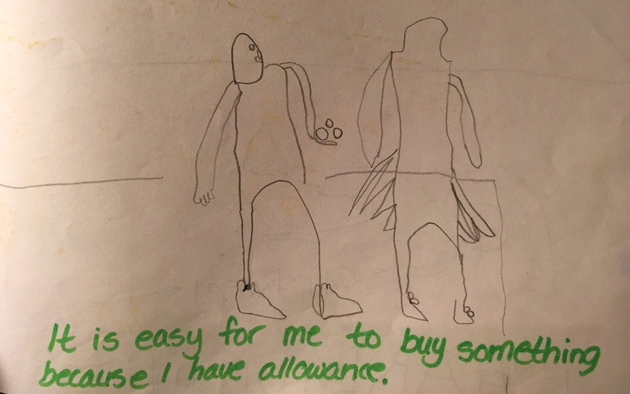
When there is a child in the classroom who experiences difficulty coming to meeting or sitting still, or children have outbursts and behavioral issues, we often skirt around these difficulties with the entire group.  Using a book like this one to foster conversation allows us to say, "It is hard for Cheri to sit at meeting but it is easy for her to add lots of details to her pictures." "It is hard for Michael to control his body all the time but easy for him to do the monkey bars."  Here are some examples from drawings children ages 3-5 did after hearing this book and being asked,

"What is hard for you to do and what is easy for you to do?"  The pages were made into a class books to be read over and over.


When we communicate that everyone is indeed working on something we allay children's fears about the outburst of a peer, the communication skills of a classmate, their awareness of their own difficulties, and teachers now have language to address the inevitable situations where children experience frustration and notice their efforts compared to others.

Some colleagues in Somerville found this video of Is it Hard? Is it Easy? on Youtube. Others read the book and are making their own class books to share.  All classrooms have a range of learners and at a time when were are striving for inclusion being able to speak openly about children's needs creates a level of equity and empathy in our classroom communities.

What are you working on?

Sunday, September 25, 2016

Starting the Year off Right: Developing a Choreography of Practice


Our last post was way back in June and is worth a review as you start your year.
What do our children want and need as they start school this year? Somerville teachers brainstormed last spring and will be revisiting this list throughout the year as they begin to develop a curriculum approach and framework (with a generous grant from The Taly Foundation) that meets the needs of our diverse learners in Somerville. For the last few years I have been listening to teachers talk about the struggle of balancing academic content with the play they know children need.  It is tricky business and teachers work in an environment of competing interests - what they know children can do, what they need to do it, and what the curriculum demands ask them to do.  And things don't always match up. Here is their list:


Children can....Children want to...
  • Talk about their home life and family
  • Feel like they are part of a group
  • Touch, explore, create, discover
  • Be independent
  • Think 
  • Be challenged
  • Be taken seriously
  • Feel successful 
  • Make connections
  • Be seen and known
  • Play

Children need....
  • To feel loved by their community
  • To use their imagination
  • Language(s)
  • Interesting materials & motivated by interesting experiences
  • To repeat activities
  • Time
  • Choice
  • Confidence
  • To feel safe
  • Respect
  • To have leadership opportunities

This list is more than just the collective wisdom of experienced early childhood educators. An article last year in The Atlantic that has been making the Facebook rounds again is worth digging into and supports what our Somerville early childhood educators are trying to accomplish. 

"New research sounds a particularly disquieting note. A major evaluation of Tennessee’s publicly funded preschool system, published in September, found that although children who had attended preschool initially exhibited more “school readiness” skills when they entered kindergarten than did their non-preschool-attending peers, by the time they were in first grade their attitudes toward school were deteriorating. And by second grade they performed worse on tests measuring literacy, language, and math skills. The researchers told New York magazine that over-reliance on direct instruction and repetitive, poorly structured pedagogy were likely culprits; children who’d been subjected to the same insipid tasks year after year after year were understandably losing their enthusiasm for learning."

So what to do?  It seems there are some unintended consequences of a well-intentioned focus on readiness. We have to pay even more attention to the relationship between instruction, the materials & experiences offered to children, the environment we set up, and strong child-child and teacher-child connections.


Again from the Atlantic: "We neglect vital teacher-child interactions at our peril. Although the infusion of academics into preschool has been justified as a way to close the achievement gap between poor and well-off children, Robert Pianta, one of the country’s leading child-policy experts, cautions that there is “no evidence whatsoever” that our early-learning system is suited to that task. He estimates that the average preschool program “narrows the achievement gap by perhaps only 5 percent,” compared with the 30 to 50 percent that studies suggest would be possible with higher-quality programs. Contrasting the dismal results of Tennessee’s preschool system with the more promising results in places such as Boston, which promotes active, child-centered learning (and, spends more than twice the national average on preschool), lends further credence to the idea that preschool quality really does matter."

To be clear:
This is NOT a call for a "just let them play" free-for-all approach.  We know that children flourish when they have freedom within structure, and when teachers engage them in compelling, challenging curriculum.  This requires much choreography behind the scenes and micro-practices that need to become part of teacher education and professional development. The blog this year will focus on the practices required to do this dance of competing interests and create early childhood settings where children and teachers build relationships that promote learning. 

Here are links to some past posts that are particularly appropriate to this topic and to the start of the school year:

Boss of the Paints
Sensory Tables
Choice Time - Executive Function
Choice Time - Self Regulation
Save My Work

Hope your year is off to a good start!


Sunday, June 5, 2016

Children can...Children want to....Children need.....

For many teachers the school year is winding down.  Others are gearing up for summer programming and still other teachers in childcare continue to support their children's growth all summer long. Whatever your context, it is always an insightful exercise to think about what our children can and want to do and link that to what children need.   Early childhood educators in Somerville, in preparation for conversations about curriculum and assessment, recently took some time to think about just this.   The teachers engaged in a Chalk Talk after doing some thinking about what children can and want to do.  It was a reminder for teachers about their deep-seated values related to teaching and learning.

Children can....Children want to...
  • Talk about their home life and family
  • Feel like they are part of a group
  • Touch, explore, create, discover
  • Be independent
  • Think 
  • Be challenged
  • Be taken seriously
  • Feel successful 
  • Make connections
  • Be seen and known
  • Play

It is a powerful list. Imagine classrooms where this happens all the time.  How might our teaching support this image of the child"?  Loris Malaguzzi, the education pioneer behind the Reggio Emilia approach spoke often of the importance of building strong images of children:

What we have to do now is draw out the image of the child, draw the child out of the desperate situations that many children find themselves in. If we redeem the child from these difficult situations, we redeem ourselves. Children have a right to a good school — a good building, good teachers, right time, good activities. This is the right of ALL children.

At the same time that teachers generated their ideas about what children can and want to do, they also made connections to what children need in order to learn - beyond of course the basic needs of food, shelter, etc.


Children need....
  • To feel loved by their community
  • To use their imagination
  • Language(s)
  • Interesting materials & motivated by interesting experiences
  • To repeat activities
  • Time
  • Choice
  • Confidence
  • To feel safe
  • Respect
  • To have leadership opportunities
This equally powerful list speaks to children's need to feel their power as learners. This is cultivated by compelling and interesting provocations and the list begins to address some practices that support children's learning experiences and their evolution as learners.  

Teachers in Somerville will be thinking about this as they work on curriculum and assessment development in the coming year with generous support from The Taly Foundation, an organization committed to making sure every child has access to high quality preschool education.

Whether you are winding up your year and thinking ahead to the fall, or continuing to teach this summer, consider what you think children can and want to do, and what they need to do it.  Do you provide the space for the things you believe in?  Why or why not?  What would need to change for you to have your teaching experiences reflect these lists?  

We will continue to blog this summer share ideas and practices - what would you add to these lists? How would your colleagues or staff respond?   Might you wind up or kick off your school year with this exercise?  We would love to hear about your images of children!


Thursday, April 28, 2016

Engaging With City Hall


On Wednesday, April 13 the children of Somerville and their teachers filled the Aldermanic Chamber at City Hall with their bodies, voices, and spirit.  They were there to celebrate the Week of the Young Child, a National Association for the Education of Young Children sponsored week that raises awareness of early education and care. Children from Somerville Public Schools and local childcare centers, as well as families from Somerville Family Learning Collaborative playgroups and English classes joined to honor our community helpers in response to a letter Mayor Joe Curtatone wrote to children asking, Who are the helpers in our city and what makes them special? 

An important component of this event was to engage children with City Hall.  Teachers in the Kindergarten Readiness Group (a professional learning community that brings public school teachers and center-based teachers together) read the article, Engaging City Hall (Krechevsky, Mardell, & Romans, 2014), and this inspired the group to ask the Mayor to write a letter to children. Many classrooms embarked upon research and created projects to answer this question.

Children from the Capuano Early Childhood Center, the YMCA Preschool, the Somerville Childcare Center, Bright Horizon's Teele Square, and Pooh and Friends Childcare Center were among those who participated. Children from the Community Action Agency of Somerville Head Start received a visit from the Mayor.

This inspiring day showcased Mayor Curtatone's commitment to developing a high quality early education system that meets the needs of our diverse community.  In its second year, our Week of the Young Child celebration is now a tradition and we look forward to next year!


Children sang with Maura Mendoza and Guillermo Ortiz in multiple languages including a song written especially for the occasion Hola to the Mayor, voted, made art with the Beautiful Stuff Project, and interacted with police, fire fighters, and other city workers. Our high school students from the Child Development Program in our Career and Technical program read Children's Rights and student musicians heralded the Mayor with their trumpets! 

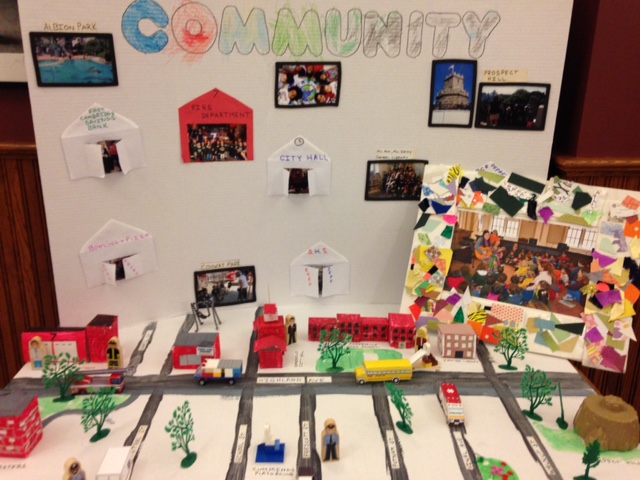
Children brought the Mayor their projects about the community and they are on display in City Hall now. Children made books about community helpers, places to play in Somerville, life-sized workers, and a model of the city.  One child even came dressed as the Mayor! 

Mayor Curtatone greets a potential future mayor and firefighter!
   
Children voted for what kind of playground feature they like best.
The vintage ballot boxes "ding" when the ballot goes in.

Children at Pooh and Friends Childcare Center created a model of their neighborhood.  They are right down the street from City Hall and walk by in as they visit area playgrounds. 

Children engaged with members of the police force, department of public works, and fire fighters.
Children from the YMCA Preschool, Bright Horizons Teele Square, and Ms Jouvelakis' SPS Kindergarten Class made class books about the community and local parks.

Children from Annemarie Cameron's Kindergarten Class made life size community helpers.


Thursday, April 14, 2016

It's.....a Baby!: An Intergenerational Baby Shower in Somerville.

Somerville Family Learning Collaborative/Council on Aging Intergenerational Baby Shower!

Eager voices filled the community room at the Somerville Council on Aging on Tuesday, April 5.  Joint planning between Somerville Family Learning Collaborative of the Somerville Public Schools (SFLC) and Cindy Hickey, Director of the Council on Aging led the first intergenerational baby shower that was enjoyed by over 60 city residents. This event brought together new or expectant parents and older adults in the community to celebrate the journey of parenthood, build community, connect generations, and provide information about community resources.  Attendees represented a microcosm of Somerville, ranging in age from infants to octogenarians, coming from countries in Europe, Asia and the Americas, sharing stories about coming to the United States and living in Somerville. 

The new Somerbaby Project was introduced by David Blumsack from the Somerville Kiwanis Club, which provided start-up funding.  This new initiative focuses on welcoming Somerville newborns by providing their parents with welcome bags full of information, resources and connections. Elders made or donated baby clothing and supplies, and brought wonderful food to share. The Council on Aging provided a generous, hot meal for everyone.  Liza Kitchell entertained the crowd with songs to sing and move to.  The Beautiful Stuff Project supplied blank books and collage materials for young and old guests to design and create their own memory books. Katey Duchin, a graduate student at the SFLC from the Boston University School of Social work, organized and solicited donations to provide multiple gifts, from diapers and clothing to toys, for each family. Representatives from the Cambridge Health Alliance and Women Infants and Children (WIC) distributed resources and materials.  
We hope this becomes a tradition in Somerville and look forward to the next shower!